


Free written scope consultation - allowances, timeline, and change-order rules on paper before a single trade is scheduled
Silestone Kitchen Remodeling: The Austin Owner’s Guide
Silestone kitchen remodeling in Austin typically runs $14,000 to $45,000 for a full renovation, which includes replacing or repairing your existing Silestone countertops, adjusting the substrate, and rebuilding the surrounding kitchen to match. We stock Silestone-compatible edge profiles, seam kits, and adhesive systems on our trucks, so most Silestone repairs or section replacements start the same week you call. The way most Austin homeowners discover a problem is subtle at first: a hairline crack near the sink cutout, a seam that has separated and begun collecting crumbs, or a dull patch where the resin has worn through from years of citrus and hard water. By the time you notice it, the failure has usually been developing for months.
Here’s what you need to know: Silestone is a quartz product, which means it is roughly 93% crushed natural quartz held together with a resin binder. That resin is what fails first in a Texas kitchen. Heat from a pan set directly down, UV exposure through an east-facing Austin window, or years of standing water at the faucet base will break the bond. Once the resin fails, the surface gets chalky, stains soak in, and cracks spread fast. We see it regularly in neighborhoods like Mueller, Tarrytown, and Circle C.
One thing up front: Mason Remodeling Co Austin is an independent contractor. We are not affiliated with Silestone or its parent company. What that means for you is we repair and remodel Silestone counters without pushing you toward a full replacement unless the slab genuinely cannot be saved. Isaac Pruett has been straight about this from his first year on the job: “Tell me what’s wrong with it. We’ll figure out what it actually needs.”
Which Silestone Models This Applies To
Silestone has been produced in Spain as part of the Cosentino family of surfaces since 1990, and the product line splits into three general series we work with in Austin homes: the Classic series (original colors like Blanco City and Negro Tebas), the Eternal series (the mid-2010s refresh), and the current Sunlit Days and Loft series launched from 2021 onward. Most of the kitchens we remodel in Austin were built between 2005 and 2018, so they sit in the Classic and Eternal ranges. Here’s the compatibility gotcha: Silestone changed its thickness standards around 2014. Older slabs in the Classic series were commonly fabricated in 2cm (about 3/4 inch) thickness with a laminated edge to bulk it up. Newer Eternal and Loft series slabs sold in the US are almost always 3cm (about 1-1/4 inch). A 2cm remnant cannot be edge-matched to a 3cm slab without a visible step, so if you have a damaged section on an older counter, we’re often matching the whole run rather than patching one piece.
Identifying your exact Silestone color is a real problem if you bought the home instead of the countertop. The original homeowner rarely leaves the product label behind. Turn over a sample or look at the underside front edge near the sink: many fabricators etch the color name and run number there. If that’s gone, we’ll pull a small chip from an inconspicuous doorway transition and compare it against the current Silestone catalog. Cosentino discontinues colors without notice, and Austin’s climate has a specific way of changing how a color reads. UV light at this latitude lightens certain pigments within five years, so a “Blanco Zeus” installed in 2016 may no longer match a new slab of the same name. When we can’t match within acceptable variance, we’ll tell you plainly and show you the two closest current options before you spend a dollar.
On aftermarket parts: edge-profile strips, seam adhesives, and undermount sink clips do not need to come from Cosentino. We use professional-grade quartz adhesive systems that meet or exceed original bonding specs, and we carry color-matched seam kits for the top two dozen Silestone colors in Texas kitchens. The place to insist on original product is the slab itself. Aftermarket quartz from a different manufacturer will always be a close-but-not-perfect match in person, even when the color name sounds identical.
Styles & brands we work with







Signs Your Silestone Kitchen Remodeling Is Failing
- Cracks spreading from the sink or cooktop cutout. Quartz is strong in compression but brittle in tension, and every square corner in a cutout is a stress riser. Austin’s hard-water minerals and the humidity swings from air conditioning to open-window spring days cause the substrate plywood underneath to expand and contract slightly, and over time that movement translates into hairline cracking at the weakest point of the slab. Once a crack passes the edge of the cutout, it will keep running.
- A seam you can feel or catch a fingernail on. Seam separation starts because the adhesive bond degrades or the substrate shifted. In Austin, our clay-rich soils mean the slab under a raised foundation moves a measurable amount between the wet spring and the dry August heat. A seam that opens 1/16 of an inch is cosmetic. A seam that has opened enough to collect food is a structural and sanitary issue.
- Chalky, dull patches that never polish back. This is resin erosion, not dirt. It is most common around the sink faucet where water sits, and on a peninsula near a window where Texas sun hits for hours a day. Once the resin at the surface is gone, the quartz particles are exposed and the area will absorb red wine, coffee, and turmeric permanently.
- Stains that bleach out but return in a few days. With intact resin, a stain sits on the surface. With failed resin, the stain is inside the stone matrix. Bleaching it removes the surface layer but the capillary action in the exposed quartz draws the stain back up from below. You cannot clean your way out of this. The resin must be sealed or the section resurfaced.
- A counter that has visibly shifted at the wall or dropped at a joint. Silestone requires a fully supported, structurally sound cabinet base. Austin pier-and-beam homes settle. If your cabinets have shifted and the counter no longer sits flush on the cabinet tops, the slab is now cantilevered in places it was not engineered to be. That concentrated load is how a counter snaps clean through when someone leans on it.
Replacement Cost & What’s Included
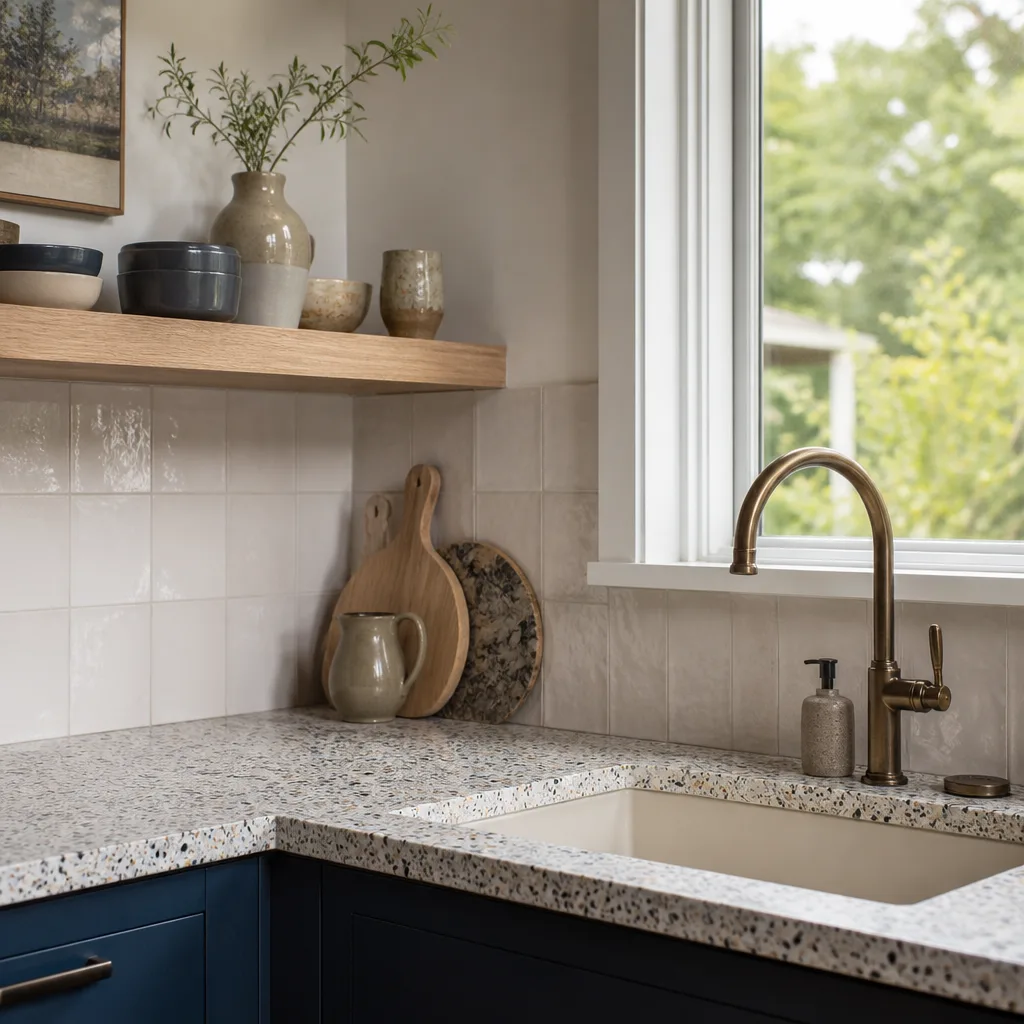
Full Silestone kitchen remodeling in Austin runs $14,000 to $45,000, with the majority of homes landing between $18,000 and $28,000. For a smaller footprint kitchen, you’re looking at $9,000 to $20,000. The countertop portion alone, including slab fabrication and installation, typically runs $2,000 to $6,500 depending on your Silestone series, square footage, edge profile, and whether there is an island. Those are the numbers we quote from, and we deliver a written price before a single tool comes off the truck.
What moves your number inside that range: the number of slabs required (a kitchen with an island may need two slabs even if the second is only 30% used, and you pay for the full slab), the edge profile (a simple eased edge is far less labor than a full bullnose or mitered waterfall edge), the existing substrate condition (Austin homes from the 1970s often need the plywood underlayment replaced), and whether your remodel includes new cabinetry, a backsplash, or plumbing fixtures at the same time. Every estimate we write breaks out parts, fabrication, labor, and disposal separately. No single line item marked “etc.” You’ll know what a seam costs and why before you sign.
Our work is covered by the 365-Day Done Right Promise. If what we install is not right within a year of completion, we come back and make it right at no cost to you. That is 365 days from the completion date, in writing, with no dispute process, no conditions, and no phone tree. One call to (903) 623-1966. A person answers.
See the difference
 Before
 After
After Before
 After
After Before
 After
AfterCan You Repair Silestone Instead of Replacing It?
Sometimes, and we’ll always tell you when you don’t need a full remodel. A single hairline crack that has not crossed a cutout can often be filled with color-matched resin and structurally reinforced from beneath with a butterfly key or steel plate routed into the underside. A separated seam can be cleaned, re-bonded, and re-flattened. Surface dullness can be mechanically polished back to a serviceable sheen. These repairs typically run $400 to $1,800 in Austin, and we do them all the time. The honest part: a repaired crack in quartz is never invisible. You will always be able to find it if you know where to look, even when the fill is good. If the counter is in a focal point like an island, we’ll discuss whether you’ll be happier long-term with a section replacement or a full resurface.
Where repair crosses into false economy: a crack running through the sink cutout, a slab that has shifted more than a quarter inch, or resin failure covering more than about 20% of the surface. In those cases, the forces that caused the first failure are still there and the repair will re-fail within 18 to 24 months. We would rather lose the repair job than sell you one we know will not last. Isaac’s rule on this is simple: if the fix is not going to hold for five years in a Texas kitchen, we’ll tell you before you pay for it.
DIY or Call Us?

Here is our honest split on Silestone work. You can safely check a few things yourself: whether the seam movement changes between morning and evening (mark the gap with a pencil line and monitor it for two weeks), whether the counter still sits flat on the cabinet top with a long straightedge, and whether water beads or sinks in on the dull patches. Those observations will save us a diagnostic visit.
What you should not attempt is any structural or cosmetic repair that involves routing, resin injection, seam re-bonding, or moving a slab. Quartz is 550 to 600 pounds for a typical 3cm island slab. It does not forgive a dropped edge. The diamond tooling required to route a proper repair channel costs more than calling us twice, and the adhesive chemistry needs controlled temperature and moisture conditions to cure properly. We have seen more than one Austin homeowner make a $600 problem into a $6,000 problem with a tube of hardware-store epoxy. If it is cracked, separated, or structurally compromised, call (903) 623-1966 and we will tell you over the phone whether it is urgent or whether you can live with it for a season.
FAQs
A full Silestone kitchen remodel takes 4 to 8 weeks from the day we start demolition, depending on cabinet lead times, slab availability from the fabricator, and whether the scope includes structural work. Countertop fabrication alone, once the slab is selected, runs 3 to 7 days. ISA section replacement can be done in 2 to 3 days if we’re not changing anything else.
Seam adhesives, sink clips, and edge profiles are available from quality aftermarket suppliers and we use them routinely at a lower cost than Cosentino-branded accessories. The slab itself is where you should stay with Silestone, because no third-party quartz will match the exact pigment and aggregate blend. Call (903) 623-1966 and we’ll tell you which part of your project can safely go aftermarket.
No. We deliver a written, line-item price before any work begins, and that number does not change unless you add scope. If we open the wall and find something we couldn’t have known about, like rotted framing behind the cabinets, we’ll stop, show you, and write a change order you approve before we do anything about it. No surprise invoices.
For most Austin kitchens, yes. Silestone holds up better than natural marble against staining, requires no sealing, and resists chips better than many imported quartz lines. Its weak point is heat tolerance and UV exposure, which is why we recommend trivets and window film in south-facing kitchens. If you love the look and understand the limits, it remains one of the best-value engineered stones on the market.
If you’re looking at a failing Silestone counter, a seam that’s opened up, or you’re ready to remodel the whole kitchen around a slab you already have, call us. We’re Mason Remodeling Co Austin, part of the Threshold Group family. A live person answers at (903) 623-1966, 24/7, including weekends and holidays. You’ll get a clear answer about whether we can fix what you have, what it costs, and exactly who will be walking through your door. That person’s name and photo come to you before the visit, and they’ll have a badge when they arrive. Written price first, on every project, every time. Free estimate, no obligation.
Written by Isaac Pruett, Owner, Mason Remodeling Co Austin at Mason Remodeling Co Austin, serving Austin and nearby areas.


